Search This Blog

Saturday, February 19, 2011

ALH84001 and Occam’s Razor

Chapter 6C

ALH84001 and Occam’s Razor

In the case of Mars, the hypothesis has been much strengthened by David McKay’s team’s analysis of the Martian meteorite known as ALH84001.[1] According to this analysis, the meteorite contains globules of carbonate, polycycle aromatic hydrocarbons (PAHs), magnetite and iron sulfides, and some intriguing structures that some believe might be the fossils of ancient Martian bacteria. We know that the meteorite, which was found in Antarctica, came from Mars because the air trapped inside exhibit the same mix of rare gasses that the Martian atmosphere has. Great care was taken to rule out the possibility that the organic materials found could be the result of contamination (a claim buttressed by the fact that the proportion of those materials increases towards the center of the meteorite). Nevertheless the reaction to McKay’s results, particularly by those scientists considered experts on meteorites, was extremely hostile.[2]

The motivation for the hostility was in no small part the fear of subjecting to ridicule the subdiscipline of planetary science devoted to the study of meteorites, to let it fall into the pit of another “cold fusion,” the big scientific embarrassment of a few years previously. The main argument against McKay’s analysis was methodological. It was based on Occam’s razor, a principle named after William of Occam, the medieval philosopher who insisted that we should accept the simplest explanation available:

All the compounds and structures found in ALH84001 could have been produced by inorganic processes. Therefore, by Occam’s razor, we should eliminate the unnecessary conclusion that we have found evidence of alien life.

As it was often repeated during the debate about ALH84001, extraordinary claims require extraordinary evidence, but hydrocarbons, the magnetite and the minute worm-like features could be explained by ordinary inorganic processes. There is presumably, then, no need to conclude that Martian life caused the phenomena found in the meteorite.

Occam’s razor, however, does not rule against McKay’s analysis. For what we have is a collection of three things in an extremely confined space (a few nanometers across): (1) typical bacterial food (hydrocarbons), (2) structures that look like typical bacteria, and (3) typical excreta of bacteria (magnetite and iron sulfides). One simple hypothesis, life, accounts for all these phenomena and the fact that they are closely packed together: Martian bugs ate the hydrocarbons and left the droppings behind. The inorganic-origins hypothesis requires at least three separate mechanisms and has little to say about why they are together in such a small space.

Some of the strongest criticisms have been made against the claim that the worm-like structures are fossils. Critics have argued, for example, that those structures formed under too much heat (but other studies support McKay on this point). But the most telling criticism was that the structures were much too small to be able to carry out many important organic functions— they came in at less than one-hundredth the size of terrestrial bacteria. This leads to a very important point I will discuss below. For now let me say that, even if those structures are not fossils, the life hypothesis is still more economical: Martian bugs ate the hydrocarbons, left their droppings, but then failed to fossilize — which is perfectly understandable for soft cells. Moreover, inorganic magnetite forms at a temperature about three times higher than that apparently experienced by the Martian meteorite. And to make matters worse, the magnetite in the sample, unlike that produced by inorganic processes, is of an extremely pure form, which on Earth is normally produced only by bacteria. It is far from obvious then that the inorganic-origins hypothesis is simpler. Occam seems to smile on the life hypothesis instead.

This is not to say that I favor the life hypothesis. For I do not believe that a matter of such significance can be decided by one single methodological point -- Occam’s razor. In any event, there seems to be little doubt now that Mars has had organic carbon, and that is a great find after the discouraging results from the Viking experiments. The sensible way to proceed -- and both sides of the controversy seem to agree on this point -- is to go back to Mars and look for evidence of fossils in places naturally protected from ultraviolet radiation.

The prospects for Europa also look good, now that the favored view is that all the origin of life requires is an environment with plenty of liquid water, organic carbon and a source of energy. Europa is ten percent water, much of it apparently in an ocean under the ice; it should have plenty of organic carbon because of its location in an area of the solar system rich in organics; and it obviously has a reliable source of energy, otherwise it could not continue to smooth out its icy surface. Let us be cautions, though, about the prospects for life on the watery moons of the outer planets, Europa for example.[3] It is not enough to have around liquid water, simple organic compounds, and a source of energy. Metals such as iron, zinc, copper, nickel, cobalt, magnesium, and manganese performed catalytic and other crucial roles in terrestrial organic evolution, as they do in the normal functioning of cells today. Without most of those metals the prospects for life in any of the outer moons would be very dim. And so we must ask whether Europa is likely to have them. The answer is yes. Europa is one of the few outer moons with a density (3.0) close to that of our Moon (3.3). Indeed the rocky core of Europa under the watersphere would have a density even closer to the Moon’s. It is a good bet, then, that it would offer a variety of metals similar to that of the Moon — and this is enough to keep Europa as one of the leading candidates in the solar system to harbor alien life.

If we never find life, or fossils of life, in Mars, Europa, of anywhere else in the solar system, astrobiology will have to look at other solar systems for specimens. Unfortunately a mission to the stars would last tens of thousands of years with the technology we can muster today. And even with the best space technology that we can plausibly envision for the next century, it would still take hundreds of years to travel to another solar system. Perhaps fancier technologies (to be described in the next chapter) can get us there faster, but those technologies will not be around in the near future. There is a shortcut available to astrobiology, and that is to make contact with intelligent extraterrestrial life. But that is a long shot, as we will see in Chapter 8.[4]

Nevertheless, even if we find no alien life in the solar system, the pursuit of astrobiology will continue to be worth our while, as we will see in a soon-to-come posting.


[1] D.S.McKay et al, “Search for Past Life on Mars: Possible Relic Biogenic Activity in Martian Meteorite AL84001,” Science, Vol. 273, 16 August, 1996, pp. 924-929.

[2] See R.A. Kerr, “Ancient Life on Mars,” ibid., pp. 864-866. The controversy spread to public arguments in the newspapers; see for example the front page article “Life on Mars: Scientists ‘thrilled’ by prospect,” Seattle Times, August 7, 1996.

[3] Other rocky moons with possible oceans include the gigantic Jovian moon Ganymede: R. Cowen, “Ganymede May Have Vast Hidden Ocean,” Science News, Vol. 158, December 23 & 30, 2000, p. 404.

[4]. For a fuller treatment of this issue see Chapter 8.

Sunday, February 6, 2011

The (so far) Unsuccessful Search for Life in the Solar System

Chapter 6B

The (so far) Unsuccessful Search for Life in the Solar System

Given this apparent potential of astrobiology, then, it is not surprising, that the Viking missions to Mars in the 1970's created great hopes of a scientific bonanza. In those missions we could for the first time examine a world where life might exist. Moreover, the harsh Martian environment offered the possibility that if life had evolved there it would be radically different from Earth's. Thus when the first experiments carried out by the robot landers seemed to indicate that photosynthesis was going on, which presumably only living things can perform, the excitement was deservedly extraordinary. But the excitement soon led to puzzlement when a chemical experiment determined that the soil possessed no organic carbon (C-H bonds). The fundamental chemistry of life simply was not there. And therefore neither was life. Now this is the way the story was told at the time and for many years after. Today, several developments have changed the picture considerably. To see the importance of those developments, let me present the picture of the post-Viking landings as it stood for almost 30 years.

The result of the Viking chemistry experiment was very disheartening to many. We find organic matter in meteorites, in comets, even in deep interstellar space. How can Mars be so utterly deprived? Experiments by Stanley Miller and others have shown that some organic molecules form easily in the presence of gases that might have existed on both the Earth and Mars shortly after their formation (essentially, Miller mixed methane, ammonia, and hydrogen in a jar, subjected the mixture to electrical discharges, and then analyzed the goo that grew in the water, which yielded some amino acids and other organic compounds).[1] It is possible that in Mars those gases did not meet in any convenient ratios, but it must be said that the nature of the Earth’s primordial atmosphere is a matter of dispute. In some scenarios, that atmosphere was dominated by CO2, which would not respond to a Miller type of experiment by producing organic compounds. The terrestrial air of today, to mention another illustration, when subjected to discharges of electrical energy, produces smog, not the organic soup of the classical Miller experiment. Even so, if we drastically reduce the free oxygen and vastly increase the concentration of hydrogen in today's air, organic compounds will still form in a Miller type of experiment. Why was life so unlucky on Mars?

At the time many suspected that the Viking missions did not offer such a grand opportunity for exobiology after all. The density of the Martian atmosphere is so low that liquid water could not now exist on it. This presents at least two problems for life. The most obvious one is that it is difficult for life to get by without liquid water — although perhaps the permafrost detected on the surface of Mars might suffice to sustain certain kinds of microbial life under the rocks.[2] The second is that when the permafrost is heated by sunlight it becomes water vapor. As the water vapor rises in the atmosphere, it is subjected to ultraviolet radiation, which disassociates the molecules of water. The freed light hydrogen atoms are eventually lost to space (Mars is surrounded by a gigantic envelope of hydrogen). The heavier oxygen could be expected to react with the substances in the soil. As we saw in Chapter 4, oxygen was a poison to earlier forms of life, precisely because it reacts so easily to form compounds. The oxidizing Martian soil would make it very difficult for organic evolution, let alone life. To make matters worse, Mars has no ozone layer and thus the ground is constantly bathed by ultraviolet radiation. All in all, some even claimed, the surface of Mars is far more antiseptic than the most fastidious operating room on Earth.

Furthermore, the Martian atmosphere shows no signs that its chemistry is being altered by the presence of living organisms. The Earth's atmosphere, by contrast, has far less carbon dioxide and far more oxygen that can be accounted for by physics and chemistry alone. Indeed, as we saw in Chapter 4, the composition of the Earth's atmosphere indicates that it is not in chemical equilibrium. And according to Margulis and Lovelock, the atmospheric gases can be kept so far from chemical equilibrium only through the action of living organisms, especially that of bacteria.[3] On the basis of this reasoning, by the mid-sixties Lovelock had predicted that no life would be found on Mars.

But is life on Mars truly impossible? Some exobiologists argued at the time that the results of the Viking experiments do not warrant such a conclusion. They tried to meet the objections drawn from the chemical experiments in the following way. First, they pointed out that life would not alter the Martian atmosphere substantially if it only existed on the margins, so to speak. Small colonies of small organisms might sustain themselves without exerting pressures on the rest of the Martian environment large enough for detection with telescopes and the Viking state of the art. Second, the unprotected surface is not the place to look. There are sites in Antarctica devoid of life on the surface, but if we care to dig we may find it in porous rocks below. Third, these exobiologists brought up numerous examples of life surviving under extreme conditions: in the core of nuclear reactors, in underground streams with temperatures of hundreds of degrees Fahrenheit, under incredible pressures at the bottom of the ocean. Organisms have been found even deep in the Earth's crust. No extreme habitat, though, is as challenging as the Don Juan Pond in Antarctica, where the salinity is so great that a random sample is likely to fail the Viking test for the presence of carbon compounds. But living organisms exist there! [4]

The claim of these exobiologists was that the Viking experiments were designed to detect average life, whereas it is clear that if any life exists on Mars it should be in extreme forms. Mars is an extreme habitat, if it is a habitat at all; experiments should be designed and interpreted accordingly. Furthermore, if life cannot be entirely ruled out on Mars, we can hope, however dimly, to find it where organic matter is plentiful: in the outer solar system. We may imagine that if life can adapt to such inhospitable habitats on Earth, it might be able to make a stand in the organic clouds of Jupiter or perhaps in some underground caves in active Io. Another moon of Jupiter, Europa, is covered by smooth ice, which indicates a good amount of internal heat. This makes Europa particularly interesting to exobiologists because under the ice there appears to be an ocean of water. Another notable prospect is Titan, the large moon of Saturn with a dense atmosphere and at least traces of organic compounds. Unfortunately Titan is too cold for life as we know it — cold enough (-288 F°) that the argument about the ability of life to adapt to extreme habitats begins to wear thin.

In any event there is a serious problem with this argument. The evidence presented can show only that once life begins it can adapt to very hostile conditions. But it does not show that life could begin in such conditions. These are two very different things. Let me illustrate this point by means of an analogy. During pregnancy, many substances can be lethal to the developing embryo, e.g., alcohol, tobacco, and hallucinogenic drugs. The chances for the new life are greatly hampered under those conditions. Once the baby is born, the situation begins to change. Eventually it may grow into an adult who smokes, drinks and abuses drugs, none of which are conducive to a healthy life, but none of which need be immediately lethal either, as they could be to the embryo. Also, life might not be able to make a start on a planet that would otherwise be exactly like today's Earth; but it surely has no trouble flourishing in it now. And as far as I know, most of the scenarios considered favorable to the birth of life are at odds with the extreme habitats of these examples. It is difficult enough to figure out how life started on Earth, as we will see presently, without the complications posed by such extreme environments. On this point we require further argument from these exobiologists of old and astrobiologists of new.

As far as Mars is concerned, however, the angels are with them. For if the Martian atmosphere was at one time much denser, life might have indeed begun; and then it might have survived, gone hail or high water. These hopes are sustained to a large extent by the tantalizing possibility that, once upon a time, Mars was far warmer and wetter, a possibility indicated by surface features that resemble river deltas and by dendritic channels also similar in appearance to river systems on our planet. These channels presumably constitute evidence of running water. As we saw earlier, in a thin atmosphere, such as the present Martian atmosphere, water goes from solid to vapor without first becoming liquid. Therefore, this evidence of running water is in turn evidence that the atmosphere was much denser once upon a time.

There are alternative hypotheses on the dendritic channels, though. According to one of them, for instance, occasional but pronounced tilts in Mars' axis of rotation would expose one of the poles to the full action of the sun. If that were the case, the melting polar cap would provide enough pressure to permit water to run off and presumably form those surface features -- all without the benefit of a dense atmosphere.[5] Photographs by the Mars Reconnaissance Orbiter, with ten times better resolution than any taken before, indicate that lava and wind-driven dust have run through those presumed river channels and gullies far more recently than water, even though catastrophic floods might have carved them once upon a time.[6]

Nevertheless the preponderance of new evidence indicates that the Martian atmosphere was far denser once upon a time and that liquid water ran on the Martian surface. The most striking findings are those of Opportunity, a Mars Exploration Rover. Opportunity found, for example, salt deposits in a region called Meridiani Planum. According to Mike Carr, the man who wrote the book on water on Mars, it is clear that a large body of water existed in that region. It is also clear that the “water had to pass through the ground to pick up the dissolved ions that ultimately were precipitated out as salts.”[7] This means that the water in that region (a lake or a sea) could not have been mere runoff from melted polar ice.

If we assume that planets similar to the Earth have similar beginnings -- in this case similar distributions of organic materials, atmospheric gases, and sources of energy -- and if we keep in mind that our own earliest fossils are about 3.5 billion years old, it seems plausible to suppose that life made a start in Mars. If that is so, the possibility exists that in some regions of Mars we may find fossils of organisms that thrived in days when the atmosphere was denser and warmer.

Although such Martian fossils would perhaps not be as exciting as living organisms, they still would be invaluable in that they would permit us to compare our form of life with an alien one. We may also be able to draw some interesting lessons from a failed interaction between life and a planetary environment.

As luck would have it, though, liquid water is likely to exist in underground deposits. The permafrost is presumed to exist to a depth of hundreds of meters, which suggests that some of water will be found in temperatures high enough to keep it liquid, if nothing else because of proximity to magma deposits and other sources of thermal energy. Martian life forms, if any exist, need not be quite as extreme after all.

Incidentally, it seems to me that the reasoning that would lead us to hope for fossils in Mars might also lead us to hope for fossils in Venus, as long as we assume that it took the greenhouse effect several hundred million years to run away and vaporize the oceans. Such Venusian fossils (or perhaps even living organisms!) would have to be found well below the surface, away from the poisonous atmosphere, just as their counterparts on Earth to whom oxygen is a poison. Most likely, though, the active geophysics of Venus, as well as its high internal temperature, would have destroyed any fossils in the rocks. 600 million years ago, the entire surface of Venus is supposed to have melted by internal processes that surely would have obliterated even the hardiest of bacteria. At any rate, looking for fossils in Mars should be far more pleasant than in a place where lead would run liquid and the clouds rain sulfuric acid.

These arguments do not establish that extraterrestrial life in the solar system is likely. All they establish is that we cannot rule it out completely. But we should remind ourselves that in order to make a case for the possibility of life in Mars or Europa, we must assume either that an extreme environment is not barrier to the origin of life or that organic evolution is likely on an environment similar to that of the early Earth. This second assumption, taken as a testable hypothesis, is what makes the search for life in Mars and Europa a reasonable enterprise.

In the case of Mars, however, such an enterprise changed from reasonable to exciting when we were lucky to receive a gift from the heavens, which will be the subject of the next posting.


[1]. For a very accessible account of the classic Miller-Urey experiment see D. Goldsmith and T. Owen, The Search for Life in the Universe, Benjamin/ Cummings Publishing Co., 1980, pp. 174- 177.

[2]. Several alternative liquids have been proposed, especially ammonia and methyl alcohol. Goldsmith and Owen offer a very accessible account of this matter also (ibid. pp. 212-216). For more technical literature the reader may consult the appropriate titles in Note 8.

[3]. L. Margulis and J.E. Lovelock, "Atmospheres and Evolution," Life in the Universe, John Billingham, ed., NASA cp.2156, 1981, p.79.

[4]. For this point of view see p. 5024. S.M. Siegel, "Experimental Biology of Extreme Environments and Its Significance for Space Bioscience," Spaceflight, ____, p. 128; Siegel et al "Experimental Biology of Ammonia-Rich Environments: Optical and Isotopic Evidence for Vital Activity in Pennicillium in Liquid Ammonia-Glycerol Media at -40 C," Proceedings of the National Academy of Sciences, Vol. 60, No. 2 (1968), p. 505; S.M. Siegel and T. W. Spettel, "Life and the Outer Planets: II. Enzyme Activity in Ammonia-Water Systems and Other Exotic Media at Various Temperatures," Life Science and Space Research, 15 (1977), p. 76; B. Z. Siegel and S.M. Siegel, "Further Studies on the Environmental Capabilities of Fungi: Interactions of Salinity, Ultraviolet Irradiation, and Temperature in Penicillium," Gospar Life Sciences and Space Research, Vol. 8, R. Holmquist, ed., Pergamos Press (1980), p. 59.

[5]. Science on radial shift as cause of dendritic channels

[6] Science, Vol 317, September 21, 2007. “Special Section: Mars Reconnaissance Orbiter”, pp. 1705-1719.

[7] M. Carr, “The Proof is in: Ancient Water on Mars,” The Planetary Report, Vol. XXIV, No. 3, May/June, 2004, p.11.

Saturday, January 29, 2011

THIRD CHALLENGE: SPACE BIOLOGY

Chapter 6A

THIRD CHALLENGE: SPACE BIOLOGY

The well-being of human life has been the ultimate justification for the physical branches of space science. But can we justify the space science of life itself? What is the value of doing biology in space? Many observers, space scientists included, do not think highly of the scientific prospects of the field. The main purpose of this and the next few postings is to meet their objections, to show that the study of life in space also shows the serendipitous, deep practicality of the other space sciences.

Space biology can be roughly divided into two main areas. The first investigates the possibility of extraterrestrial life; it goes by the name of exobiology, or, more recently, astrobiology. The second investigates the behavior of terrestrial life in outer space; it corresponds to the idea most laymen have of space biology[1]. Since these two areas are distinct, they require separate analysis and separate justification.

Exobiology/Astrobiology

Introduction.

It used to be said with derision that exobiology is a science without subject matter. We have never found any alien life, and for all we know terrestrial life might be the only life in the universe. Or even if there is life somewhere else we might never find it. Or if we stumble upon it by chance, we might not recognize it as life.

Exobiology did have its moment of fame in 1975 with the Viking missions to Mars; but, after the Viking landers failed to find life, the field steadily declined in prestige and seemed moribund until two extraordinary developments resuscitated it.

The first was the dramatic advance in the search for planets around other stars. In the last few years hundreds of extraterrestrial planets have been discovered, most of them gas giants even larger than Jupiter, but we are also beginning to find rocky planets a bit larger than the Earth. This development was extraordinary because even the best telescopes were not expected to take pictures of planets many light years away from us. Some researchers had claimed to detect the presence of large planets by the wobble they caused on the paths of their parent stars, but it was generally agreed that such “wobble” was comfortably within the margin of error of the observations. Researchers hoped that a generation of space telescopes yet to come might help, until some clever astronomers invented a completely novel approach: the tug and pull of a planet on a star, if they are both on our line of sight, will make the star move away or toward us. That means that the star’s light would be shifted towards the red, if the star is moving away from us, or towards the blue if it is moving towards us. Spectral analysis, thus, has made the discovery of new planets routine. The planets found so far are very close to their stars, even closer than Mercury is to the Sun, but that is not to say that all extraterrestrial planets are that close. It should be expected that the first planets we found by measuring how much their gravitational pull disturbs their stars’ orbits should be precisely those that are very close to their stars. All these discoveries have been supplemented by the observations, with infrared telescopes mostly, of planetary systems in formation – observations that make plausible the existence of terrestrial planets throughout the galaxy.

The second extraordinary development was the discovery of organic compounds in a Martian meteorite (ALH84001), and the tantalizing suggestion that some worm-shaped structures found inside might be fossils of extremely small Martian bacteria. The monumental excitement created by the announcement led to a very ill-tempered controversy between groups of scientists that I will discuss later in this section. Both sides would agree, however, that the discovery of extraterrestrial life would give us good reason to get excited. For by comparing terrestrial and extraterrestrial life we would learn much about our own life and our own planet.

We can readily see that the possibility of such a comparison may provide an excellent motivation for the pursuit of exobiology, and so this will be the first issue I will discuss. I will then examine the negative results of the search so far and evaluate the hope created by the Martian meteorite. And, finally, I will determine why it makes sense to continue doing astrobiology even in the face of uncertain results.

1. The Motivation for Astrobiology

What would extraterrestrial life enable us to learn about our own kind of life? The answer is clear. All life on this planet is based on the same carbon chemistry and apparently all have the same genetic code. Of the many possible amino acids, only twenty are used to build proteins. DNA, the reproductive code for terrestrial life, makes use of only four bases. Moreover, organic molecules can be left handed or right handed, but terrestrial life prefers left-handed amino acids and right-handed sugars. Are these circumstances mere accidents of organic evolution, or are there fundamental reasons why life has taken these particular turns on this planet? Even one other kind of life would permit us to make great strides in examining these matters. For that other life may use a wider range of amino acids and bases, or it may prefer right-handed amino acids or left-handed sugars. One result of such a finding may be that, say, a particular chemical balance in the Earth’s oceans caused the preference for left-handed amino acids. Or the alien life may be similar to life on Earth, which would reveal to us some sort of organic inevitability. In either case, if we have knowledge of the natural environments of that alien life, we can begin to understand why certain paths open to organic evolution are conducive to replication. The new perspective would be very fruitful in trying to understand our own biology at all levels.

It would be especially useful to observe stages of organic evolution and to study life as it begins in a new world, or at least to find fossil records of such beginnings. Beyond the stage of primitive cells, radically different alien forms of life would still offer great rewards, as we will see below. Even if perchance organic evolution produced in two similar planets similar primitive cells with essentially the same genetic code, the subsequent evolution would have much to teach us, for life in those two planets would undergo different histories of adaptation. Imagine, for example, that the now famous Alvarez asteroid had not crashed on the Earth. No one knows how dinosaurs would have continued to evolve, but it is possible that their grip on the surface of the planet would have been further strengthened. Mammals might have been thus forever condemned to crawl and scratch in the night like so many other vermin.

Even similar planets are likely to exhibit different tectonic histories. Plate tectonics brings continents together or breaks them apart; it throws chains of mountains up over the landscape; and it creates volcanoes where the plates rub against each other. In doing so it brings some habitats to an end and others into existence; it destroys; it influences; it changes life in many ways. Consider how the variation in the size of landmasses influences the fauna and flora of a planet. Certain large animals, for example, need a large environment in which they can roam for long distances. Elephants used to travel many hundreds of miles in their annual migrations. As these big mammals went along, they ate a variety of plants, thus insuring a balanced diet and permitting the vegetation at every feeding stop enough time to recuperate. Their considerable droppings were recycled, in the meantime, by armies of insects and bacteria. In a much smaller environment the vegetation would have been devastated, and the elephants would have suffered from poor diets and the unsanitary rot of their own excrement.[2] They would not have been fit.

Slight differences at the beginning of the history of a planet would alter the make-up of the crossroads that life has to face, first at the level of organic chemistry, and then at the level of cells — presuming that cells are common to living things. A eukaryotic cell (a cell with a nucleus) may well be the result of symbiosis between different varieties of prokaryotic cells (without a nucleus).[3] For example, the mitochondria in eukaryotic cells (see Figure 1) may be the remnants of prokaryotic cells that discovered how to use oxygen for energy and were swallowed but not digested by larger bacteria. Since eukaryotic cells are the building blocks of all complex organisms on Earth, we can imagine that different symbiotic relationships between primitive cells might have led to forms of life vastly different from those of our acquaintance. On planets so endowed, the subsequent interaction of life with the rest of the environment would have a multiplier effect, for they would change their environment in novel ways, and those new environments would lead life to adaptations that on Earth could meet only with misfortune.

Acquaintance with such alternative biotas would inevitably lead to profound transformations in biology, since biology would grow, and scientific knowledge seldom grows without changes. In this, scientific knowledge resembles animals. Mammals, for example, did not just get bigger after the extinction of the dinosaurs. As their size increased, the structure of their skeletons had to change to accommodate their larger weight. In a planet with gravity similar to ours, a dog the size of an elephant would probably look much like an elephant. In an analogous manner, a science of biology that were suddenly much larger in subject matter would have to grow connections and supporting structures for which there was little need in the days of a single biota.


[1]. I do not divide the field in the manner that NASA has found convenient for a variety of administrative reasons (according to which, for example, Space Biology is only a small section of the Life Sciences Division). My division follows rather the convenience of the argument and of the reader.

[2]. Adapted from R.M. Laws, I.S.C. Parker, and R.C.B. Johnstone, Elephants and their Habitats, Clarendon Press, Oxford (1975).

[3]. For an informal, though detailed account of these issues see Gene Bylinsky, Life in Darwin's Universe, Doubleday, 1981.

Saturday, January 15, 2011

Gravity Probe B

Gravity Probe B

Instead 0f answering questions about Gravity Pr0be B, the current experiment to test the extraordinary predictions from Einstein's General Theory of Relativity I described briefly, I thought I would copy part of the experiment's website. Some of the interesting graphs did not come through in the copy, but I hope this tidbit will entice some of you to take a look. Just google "gravity prove b" and you will be right there at the horse's mouth. Enjoy.


Closing in on Einstein: Frame-Dragging Clearly Visible

The accuracy of the GP-B experimental results has improved seventeen-fold since our preliminary results announcement at the American Physical Society annual meeting in April 2007. At that time, only the larger, geodetic effect was clearly visible in the data. Over the past two and one half years, we have made extraordinary progress in understanding, modeling and removing three Newtonian sources of error—all due to patch potentials on the gyroscope rotor and housing surfaces. The latest results, based upon treatment of 1) damped polhode motion, 2) misalignment torques and 3) roll-polhode resonance torques, now clearly show both frame-dragging and geodetic precession in all four gyroscopes (see figure at top right).

The figure at lower right displays the science estimates as of September 2009, with the gyroscopes analyzed individually and combined. The estimates are indicated with colored "X"s, and the statistical uncertainty associated with each estimate is plotted with a corresponding colored ellipse.

The combined four-gyro result in the figure gives a statistical uncertainty of 14% (~5 marcsec/yr) for the frame-dragging (EW). The gyroscope-to-gyroscope variation gives a measure of the current systematic uncertainty. The standard deviation of this variation for all four gyroscopes is 10% (~4 marcsec/yr) of the frame-dragging effect, suggesting that the systematic uncertainty is similar in size (or smaller) than the statistical uncertainty.

Parallel Processing Enables Transition to 2-Second Filter Analysis

The results shown in the two figures at right above are based on a physical model of the gyroscope developed over the past four years. This model explains the changing polhode path affecting determination of the gyro scale factor, as well as patch-potential interactions between the gyro rotor and housing that induce Newtonian torques. Due to limitations in computer speed and processing power, the analysis was performed using once per orbit averaging of gyroscope orientation data (97-minute intervals), collected from the SQUID readouts and stored at 2-second intervals.

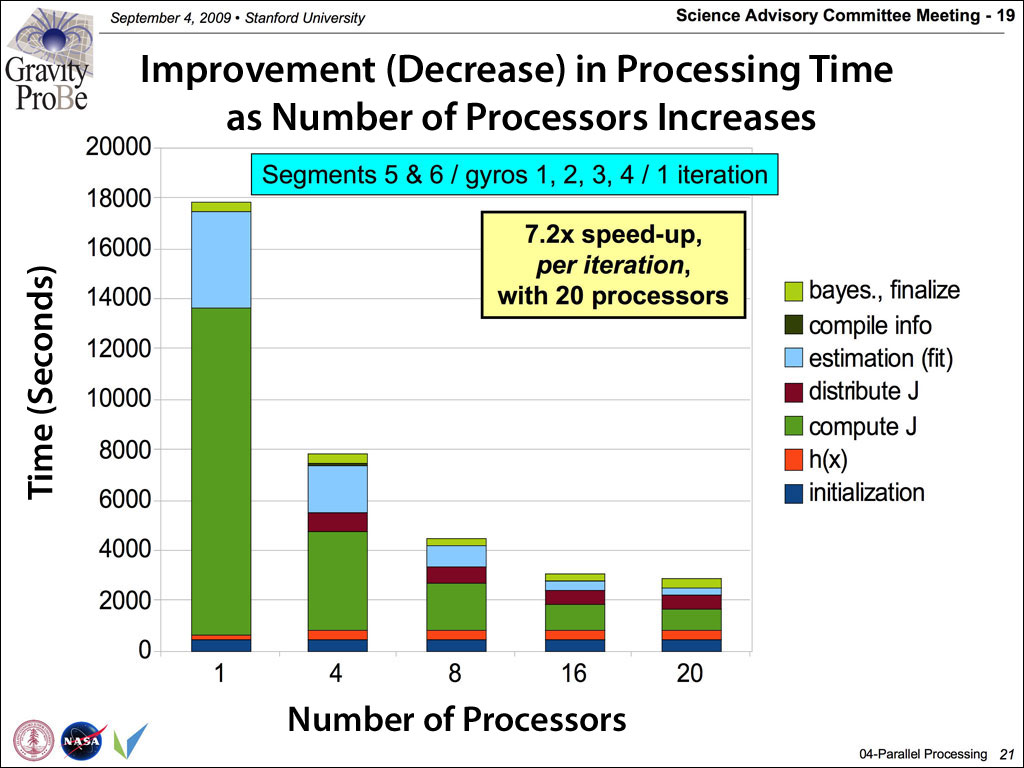
Parallel processing reductions in data analysis time.
Parallel processing enables timely
analysis of GP-B's 2-second data
intervals. (Click to enlarge the image.)

The patch potential torques act at frequencies related to the spacecraft roll period (77.5 seconds). Significant improvements in the accuracy and precision of the final results will be achieved by performing the data analysis using the physical model of gyro behavior described above with the full complement of 2-second data—the highest resolution of the gyro orientation data. This 3,000-fold increase in data points requires transitioning from stand-alone computers to multiple processors working in parallel.

With Professor Charbel Farhat as CoPI, a 44-processor cluster is now in use for this effort. Transitioning the data analysis to a high-speed computer cluster posed the latest GP-B challenge. A subset of the GP-B team, comprised of both Stanford and KACST researchers, have been developing this new capability. During the past several months, we have succeeded in reducing computation time by a factor of seven, shortening a typical data analysis run from three days to overnight. (See figure at right.)

GP-B Science Advisory Committee (SAC) Meeting #19

SAC19 photo
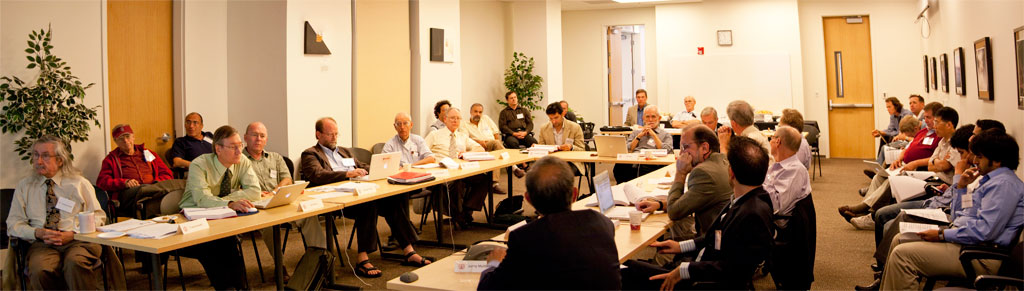
SAC Meeting #19, September 4, 2009.
(Click to view photo.)


The 19th GP-B Science Advisory Committee meeting was held at Stanford on September 4, 2009. Members of the GP-B team detailed the latest progress in data analysis methodology and experimental results to the SAC members during the all-day session. Excerpting from the formal SAC#19 Meeting Report:

“…Preliminary results [using the current analysis tools] have been very promising, again giving good agreement for the relativity drifts among all four rotors. The project now appears to be converging on a result for the frame dragging, with a realistic expectation of an error (statistical plus systematic) at the several milliarcsecond per year level."

The Presentations page in the Resources tab of this web site contains Adobe Flash versions—with synchronized audio—of the first two presentations made at the SAC#19 meeting:

  1. Introduction and Status Overview by Francis Everitt (12 min)

  2. Data Analysis Overview by John Conklin (50 min)
    John Conklin received his Ph.D. from the Stanford Aero-Astro Department in December 2008. His doctoral dissertation is the 85th Stanford Ph.D. thesis related to GP-B. Moreover, it won the Ballhaus Award for the best Aero-Astro dissertation of 2008-09. Conklin’s work on trapped flux mapping has become a cornerstone of the data analysis effort.

These presentations provide a comprehensive overview of the GP-B data analysis effort to date and a clear roadmap of remaining work.

Three-Unit Course: Aero-Astro 255—Space Systems Engineering & Design, John Mester

Photo of Aero-Astro Course #255
GP-B research scientist, John Mester,
teaching a session of his Aero-Astro
255 course. (Click to enlarge.)

John Mester, a senior GP-B research physicist, at the request of Charbel Farhat, chair of the Stanford Aero-Astro Department (and GP-B Data Analysis Co-PI), is giving a comprehensive 3-unit course this quarter on space systems engineering and design, using GP-B as a case study. Following is the course description from the department's Fall 2009 course catalog:

This course will survey systemized approaches to design, fabrication, integration, and testing of flight hardware from the component level through functional systems. The development of systems level requirements based on flow-down from mission requirements and goals will be reviewed. Systems engineering techniques related to requirements development, requirements tacking and validation and verification will be compared. The course will include an examination of risk tracking and mitigation and the cost, benefit and limits of “Test it like you fly it” philosophy. The development of the Gravity Probe B Relativity Mission will be used as a case study to illustrate key principles.

The course has attracted strong attention and great enthusiasm among the students.

Stanford Precision Attitude and Translation Control Program (PAT)

Space provides unique opportunities to advance our knowledge of fundamental physics and astrophysics, enabling new ultra-precise experiments, impossible to perform on the ground. Future space missions to carry out such experiments will require spacecraft attitude and translation control of unprecedented precision. The Stanford Precision Attitude and Translation (PAT) Control Program leverages Stanford's unique experience in having successfully flown the world's only three-axis drag free satellites, Discos/Triad and GP-B.

Photo of the ITF at Stanford.
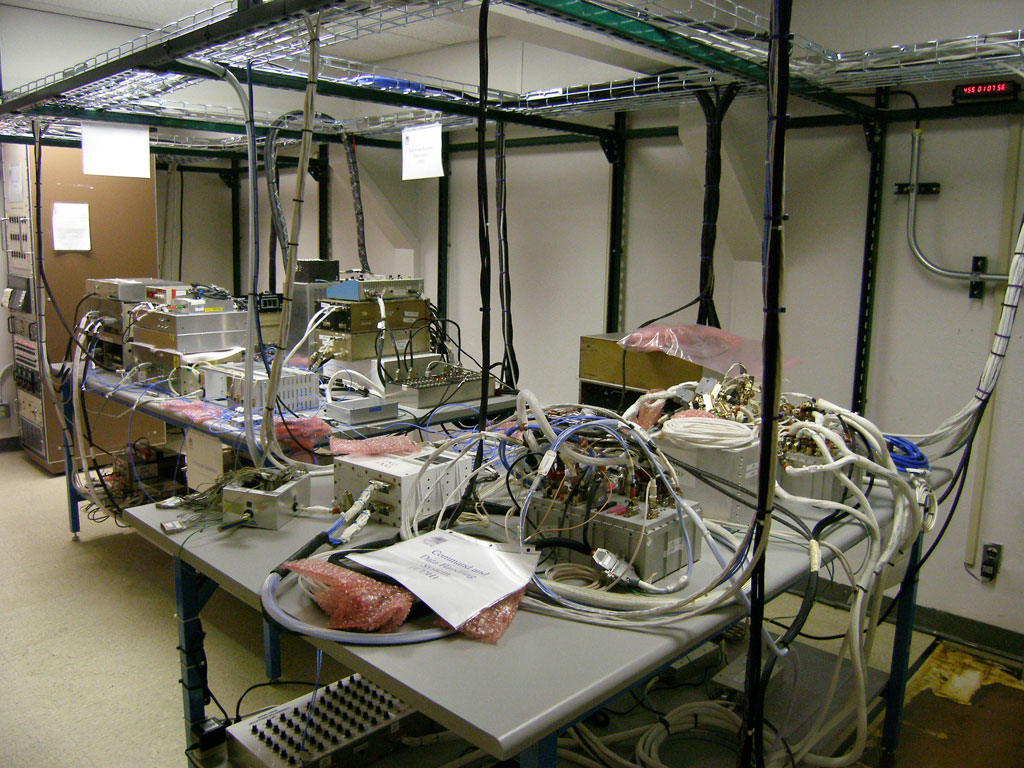
The Integrated Test Facility payload &
spacecraft simulator at Stanford. (
Click to enlarge.)

Missions requiring Drag Free Control, such as LISA Pathfinder, LISA, STEP, and BBO, rely—as did GP-B—on inertial sensors whose true performance can only be realized after launch. Two central needs are: 1 )high fidelity simulations and 2) command procedures for in-space optimization of satellite control. As evidenced by the GP-B experiment, control of vehicle dynamics requires a complex, closed-loop interaction with payload systems and must take into account issues such as fluid slosh.

The PAT Control Program focuses on high accuracy attitude control, drag free control, and payload-spacecraft interaction dynamics. On-going efforts include the implementation of advanced spacecraft environment and dynamics models, development of spacecraft and payload sensor and actuator models, error modeling, parameter identification, state estimation, control algorithm design, and command template formation to establish realistic expectations and plan post-launch tuning and optimization.

The GP-B ATC experience has attracted wide interest. The Zentrum Angewandte Raumfahrt-technologie und Mikrogravitation (ZARM), University of Bremen, Germany is developing a generic drag-free simulator to assist future science missions including GAIA and STEP. Two ZARM team members are spending a year at Stanford. Their work, in the Aero Astro Department, involves refinement of simulator core dynamics to include the GP-B spacecraft dynamics and to validate the models by comparing the simulator results with actual flight data. Ivanka Pelivan and Matthias Matt from ZARM have made a detailed simulation of the expected external disturbances on the STEP spacecraft. In addition, Valerio Ferrone, from Rome, has completed an analytic model of test mass electrostatic interactions.

The PAT Program is now poised to focus on specific use and implementation of

  1. Fully integrated sensor-controller-actuator simulations, operating across the payload/spacecraft interface
  2. Existing modular architecture to enable efficient exchange of software models for hardware units (either in the form of prototype or final flight electronics systems) for hardware-in-the-loop verification
  3. High fidelity spacecraft bus and flight CPU to enable flight software verification with the science payload.
  4. Integrated Mission Operations consoles for command generation and verification and operations training.

Collaborative Research and Program Funding

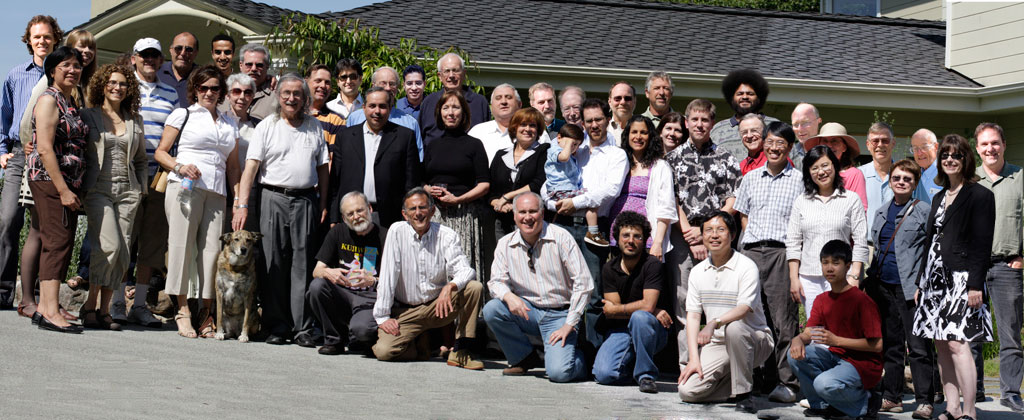
Photo of Memorial Day 2009 gathering of GP-B team members, KACST collaborators and friends of GP-B
GP-B Team, KACST Collaborators and
Friends of GP-B—May 30, 2009.
(Click to view photo.)

Current funding for GP-B is being provided as part of a collaboration between Stanford and the King Abdulaziz Center for Science & Technology (KACST) in Saudi Arabia. Beginning in August 2008, four KACST researchers have joined the GP-B data analysis team at Stanford. In addition, this collaboration has contributed to the establishment of the Stanford-KACST Center of Excellence through the Stanford Aero-Astro Department in November 2009. At right is a photo of the extended GP-B team, KACST collaborators and friends of GP-B, May 30, 2009.

Play Conklin SAC#19 Flash Presentation
Click to view/download PDF copy
of Fairbank Workshop flier.

William Fairbank Workshop on Fundamental Physics & Innovative Engineering in Space

In the Fall of 2010, we will hold the first William Fairbank Workshop on Fundamental Physics & Innovative Engineering in Space. This workshop, honoring GP-B co-founder William Fairbank, will bring together experimental physicists, aerospace engineers, industrial leaders, university and governmental managers to review past efforts and discuss future directions of space-borne physics experiments. The many technologies required to carry out GP-B will be presented in detail, and lessons learned from GP-B and other completed programs will provide foundations for new missions.

This workshop will be another step forward in fulfilling the technology dissemination mandate from the 1995 Space Studies Board NRC Task Group on GP-B, whose concluding observation strongly urged "...that the technology developed during NASA's support of GP-B be reported in the open literature for the benefit of the entire scientific community."

Finally, this workshop will be the capstone of the GP-B program, providing a venue for the formal release of the final GP-B science results, including a press conference announcing the results of this landmark experiment to the general public. Click on the thumbnail graphic at right to view a preliminary flyer about this workshop.

Saturday, January 8, 2011

SPACE ASTRONOMY AND PLANET EARTH

CHAPTER 5H

SPACE ASTRONOMY AND PLANET EARTH

Stellar systems emit strongly in the infrared during their birth. If we wish to know about the formation of the solar system the investigation of new stars with the aid of satellites such as IRAS, the Shuttle Infrared Telescope Facility (SIRTF), their successors, and the new generation of ground infrared interferometers and high-altitude balloon telescopes, is paramount (the SIRTF is 1000 times more sensitive than any other infrared system previously used in the atmosphere). And so is the search for already established planetary systems. Infrared astronomy is particularly useful in this last regard because a star's radiation is so strong relative to that of its planets, and the arc between the planets and the star so small, that the star simply does not let us see the planets in orbit around it, if any exist. At the infrared level, however, the contrast between star and planets is not quite so large, which makes this range of wavelength promising, if not for this generation of space telescopes at least for the next. Infrared observations have already identified dense disks of matter around Vega and other stars, perhaps planets in formation. The grains of dust around newly born stars are smaller than those around stars hundreds of millions of years older, in accordance with the predictions of the planetesimals theory of the formation of planets. We have by now obtained infrared pictures of such disks “from above” and have noticed circular strings clear of dust, just what a planet would do as it clears the region of space in its path. Most importantly, we have discovered hundreds of Jupiter-size planets and a few terrestrial-size planets around several stars (by using spectral analysis of those stars, so as to determine by Doppler shifts in the starlight frequency whether a large planetary body influences the motion of the star).

The next few decades of exploration will give us the opportunity of testing our most cherished theories about the formation of our own planetary system, and to settle such issues as the temperature of the newly born planets. This last issue has much to do with the story of life on our own planet. Eventually we may even test our ideas about the composition of the primordial atmospheres. As we saw in Chapter 4, to know about the Earth we needed to examine other planets. To know about our planetary system we need to examine other planetary systems, for very much the same sorts of reasons. And surely, in this task it is crucial to determine the role of the star or stars of the system.

Apart from the Earth itself no other object rivals the sun in importance for us. Life depends on it; the Earth depends on it. Thus to know what to expect from the sun has obvious benefits. For example, a variety of solar cycles seem to affect the Earth's climate. In the 17th and 18th century the famous sun spots disappeared for a period of about 70 years. As Science describes it, "Europe became so cold at that time that the Thames froze regularly and Louis XIV had the beautiful, but chill, marble floors of Versailles covered with wood parquet to keep his feet warm."

Understanding the sun better, however, requires a variety of investigations.

(1) The sun is a very complex body. Its surface temperature is 6,000 degrees, but the corona around it is about a million degrees, and in the heart of solar flares the temperature goes up to about 100 million degrees. To understand this range of temperatures, to understand the sun's magnetism (which apparently has much to do with the sun spots), we need to look at all the wavelengths in which the sun radiates energy. And in particular we need to look at it in the ultraviolet and X-ray bands of the spectrum. The plasmas, the magnetic and nuclear properties, and the structure of the sun are beginning to be explained by solar physics, some of which must unavoidably be done in space.

(2) To understand the internal environment of the sun it pays to try to understand the sun as a star. We can use vibrations on the sun’s surface as evidence of waves that travel through the interior of the sun, and which in turn give us evidence about that interior. But these observations need to be interpreted in light of our theories of the nature of stars. To calibrate these theories properly we need to study many other stars. And this in turn requires, in part, the help of telescopes placed in orbit. For the variations in the behavior of stars can be determined only by observing the full spectrum of their radiation.

(3) To know what a star may do, we need to have some inkling of its evolution, just as it was the case for planets as well. In this regard it becomes extremely helpful to look at many stars in different stages of evolution. But this evolution must be seen in the context of the galactic environment in which it takes place. We want to know the chemical composition and distribution of the gas and dust in the galaxy, how they form proto-stellar clouds, how those clouds collapse, how is the collapse affected by the other events (e.g., supernovas), and why the gas between stars is so hot (the solar system seems to be engulfed by a gas hot enough to emit X-rays: one million degrees!). As it turns out, most of the mass in the galaxy and many of the most telling events are invisible. We need unusual detectors in some cases (e.g., neutrino detectors in the middle of gold mines), but most often we require the space telescopes, and their complementary high-tech new ground telescopes, that can give us a reading of the full spectrum of electromagnetic radiation.

In these three respects space physics and space astronomy complete the task of comparative planetology that we discussed in Chapter 4. It is fair, then, to extend the same sort of justification to them. We have thus one more illustration of my thesis that serendipity is a natural consequence of science.

CONCLUSION

Space physics and space astronomy have thus been shown not to be exceptions about the theses on the nature of science that I advanced in Chapter 3. Some of their activity completes the task that justified comparative planetology (e.g., solar physics and the astronomical efforts to put it in the proper context). And other was shown, against the objection, to be fundamental science, and therefore it should be presumed to exhibit the natural connection with serendipity used to justify scientific exploration in general.

I cannot deny that much of what space science proposes to do sounds very esoteric. But so have sounded nearly all the revolutionary advances in the history of science. In some instances the masses and energies that we wish to study with the aid of space are as large as the effects that we wish to measure are small in other instances. How could they be of practical relevance? Equivalent questions to those we ask now about the relevance of general relativity, for example, could have been asked earlier of the special theory as well. Relativistic effects become pronounced only at extraordinary velocities (close to the velocity of light, 300,000 Km per second). But what regular person is ever going to travel at that velocity? Someday we might, actually, but the point is that those strange effects do show up in particle accelerators and make their way into our contemporary physics. Indeed much of contemporary physics is based on the study of phenomena so small as to be beyond the conscious experience of any regular person. The grand man of atomic physics himself, Niels Bohr, often remarked that it was pointless even to ask questions about the reality of the processes of micro-physics. Nevertheless, the study of the remotely small and the remotely fast has produced surgical lasers and many other beneficial wonders in our time. We have no reason to expect fewer rewards as our playful science moves into the cosmos.

Sunday, January 2, 2011

TRANSFORMATION BY CHALLENGE

CHAPTER 5G

TRANSFORMATION BY CHALLENGE

One of the ways in which exposure to unusual circumstances serves as a catalyst in the process of conceptual transformation is that it can help turn theoretical science into experimental science. To illustrate how space science plays that role, let us consider Einstein's General Theory of Relativity. Perhaps the most important insight of this theory is that the geometry of space and time (spacetime) is affected by the amount and distribution of matter (or rather, mass-energy) throughout it. This point is difficult to grasp but it can be illustrated by means of the following analogy. On the surface of a regular coffee cup draw two points and trace the shortest line between them. The length of this line is going to be independent of the amount of coffee in the cup. Similarly, we would expect the properties of space and time to be independent of the "stuff" that makes up the universe. But consider now that the cup is made of some highly elastic material (say, the rubber used in toy balloons). In such a case not only the length of the line but the very shape of the path will be determined by the amount of coffee and by the way we squeeze the liquid about in the cup. Just as the geometry of the cup is affected by the liquid in it, Einstein might say, the geometry of spacetime is affected in a similar way by the matter in it. Thus the paths that light follows (geodesics) will vary from region to region; the universe as a whole will be curved; and time will slow down in the presence of strong gravitational fields (for it will be as if light had fallen into a deep hole-- and so it will take longer to come out of it--which means that even the most efficient clock, using light signals, would measure time more slowly).

To put it in a nutshell, the theory claims that the geometry of spacetime tells matter how to behave and that matter tells spacetime how to curve. Massive objects thus distort the geometry of spacetime (this is the effect of gravitational fields). And such geometry (or "shape", to state it colloquially) determines, for instance, how light can move through different regions of the universe. Near the Earth spacetime is almost flat, and thus it is very difficult to perform experiments to test Einstein's insights. As a result, for a long time there were only three tests of the theory. The most famous checked the prediction that stars directly behind the sun should appear shifted to the side of the sun. This should be expected, if the theory is correct, because the mass of the sun carves a sort of a basin out of the fabric of spacetime. Light coming very near the sun would follow the contours of the basin, and thus be deflected; but it would also be "delayed", for it now has longer to travel. Unfortunately, the sunlight does not permit a check of this prediction except during eclipses. Even then tests were difficult. Nonetheless, they favored Einstein's theory, since during eclipses the stars in very close proximity to the sun were seen shifted away from it within the range of Einstein's prediction.

With the advent of space exploration, however, relevant and far more precise tests can become almost routine. Einstein's prediction is not really limited to light, but extends rather to all electromagnetic radiation, of which visible light is only one form. Thus we can test Einstein’s theory by tracking the radio signals of satellites that circle the sun, or the radio signals from the Viking landers on the surface of Mars when Mars goes behind the sun. That is, we can check not only the prediction about the deflection of light but also about its delay.

We can also check some other startling predictions of the theory, such as the claim that gravity slows time (for clocks should then move faster the further away from massive bodies). Although it is possible to make this last kind of test using only terrestrial science, space offers much greater sophistication and permits far more ambitious developments along these lines. Already it permits us to use very precise clocks in spaceships whose distance from several points is determined to high accuracy by tracking stations using lasers. The advances in chronometry are respectable enough that the entire field goes beyond applied science into engineering.[i]

Of extraordinary importance would be the discovery of gravity waves, for they would provide an entire new window to the universe since matter is transparent to them. Joseph Weber and others have tried to detect gravitational waves by means of extremely sensitive aluminum cylinders and other ingenious devices. Unfortunately the problem of discriminating between true gravitational waves and "noise" caused by other factors has rendered inconclusive the results of most experiments along these lines. In space, however, the availability of very large baselines, e.g. between a station near the earth and a spaceship, permit us to search for gravity waves of different frequencies. Just as Weber expected his cylinders to vibrate whenever a gravity wave went by, we could expect the station-spaceship baseline to oscillate whenever we observe gravitational events of cataclysmic proportions. The opportunity to observe such events will be offered by space- based telescopes trained on pulsars, the vicinity of possible black holes, and other cases of very dense matter, all of which would allow us to see just how well Einstein's ideas fit the world, and to correct or replace them as circumstances and our imagination dictate.

In addition to all this, space exploration makes possible what some like to call "crucial experiments" between General Relativity and some of its sophisticated competitors. Dicke's theory of gravitation, for example, predicted many of the results of Einstein's that we have already discussed. But it differed in some respects. In particular, it predicted that the Moon's orbit is deflected toward the sun. The predicted change in that orbit was so small, however, that a test was out of the question until the landing of Apollo 11 on the Moon. The first humans on the Moon installed a reflector (the first of a series now in place) for a laser beam from Earth. This special equipment has permitted extremely precise measurements of the distance between the Moon and the Earth, thus setting up an experiment that pits Dicke's theory against Einstein's. Einstein's won.

In this new era of telescopes we have also been able to perform some striking confirmations of Einstein’s theory. For example, the theory predicts that large masses may serve as “lenses.” Essentially, a large mass conveniently situated in the line sight between a source of light and the observer will split the light around its body. We have now been able to observe this gravitational lensing on many occasions.

As in these cases, such experimental work is not only entirely new but often requires the contribution of space science. And the most fascinating experiments are yet to come. Of particular significance is Gravity Probe B, the orbiting gyro experiment directed by Francis Everitt at Stanford University. This experiment is now testing the general theory of relativity in two most significant respects (it was originally scheduled to be launched by the shuttle in the late 1980s, but it has finally be placed in orbit only recently). According to Einstein's view, the distribution of mass determines the geometry of space-time. But when a big mass rotates, it places space-time in motion as well, that is, it drags space-time along. To make a very precise calculation of the value of the drag we have to know very precisely the values of the mass and the rotation involved. These values have been determined for the Earth, which also has a mass big enough to permit, according to the theory, a small but detectable amount of space-time drag. Four small, nearly perfect spheres – gyroscopes – placed in polar orbit would have their rotational motions affected by such a drag. The object of the experiment is to measure that effect on the rotation--more specifically, the precession of the spheres with respect to the fixed stars--and see how it agrees with the values predicted by the theory.

It is perhaps ironic that this experiment so much resembles one of the most celebrated experiments of the 19th century, the Michelson-Morley experiment, which by failing to detect any ether drag later made more acceptable to many physicists Einstein's special theory of relativity. By giving real properties to space-time in his general theory, it seems that Einstein introduced into physics something that performed functions in the new theory not unlike those of the ether in the old. Now his own general relativity will be put to a similar test. Unfortunately for Everitt and his team, space shuttle delayed his experiments so much that different experiments, using telescopes, have apparently demonstrated this drag already.

In any event, Everitt’s experiment has a double purpose. It also aims to measure a most startling prediction of the general theory of relativity. When an electrically charged body rotates, it produces a magnetic field. Because of the structure of general relativity, we can ascribe a similar effect to rotating gravitational masses. That is, a field should be produced that would create torques on the orbiting gyroscope (this would lead to what is called the "gravito-magnetic precession of the gyroscope"). A positive result of this experiment would confirm the existence of magnetic-like properties of gravity, a discovery of the most extraordinary importance.

A great deal of advanced technology has been necessary in this experiment, involving sometimes a million-fold improvement in precision over previous technology. The four spheres so perfect that, if you blew one up to the size of the Earth, it would not show a deviation from the average radius larger than two feet. Such sphere must be suspended without friction, and its minute precessions must be measured (one of 6.9 arcseconds per year, the other 0.05 arcseconds per year). These specifications can be met in space after considerable ingenuity and effort. The quartz spheres are coated with metal and suspended by the action of small electric fields. Their rotation is monitored thanks to the fact that since it will be electrically charged and rotating it will produce a small magnetic field.

On the Earth thousands of volts would be required to keep the spheres suspended, with many unwelcome side-effects added to a variety of disturbances typical of the environment--atmospheric, seismic, human, and so on. But even if all those things are accounted for, gravity alone would demand a degree of perfection in the spheres simply unattainable. The reason is that insofar as the spheres are less than absolutely perfect their individual center of mass will vary slightly from the center of a perfect sphere of the same radius. The stronger the gravitational field, the larger the rotational distortion produced by such a variation. Given the desired experimental performance – 3 x 10-11 degrees per hour – under the gravitational acceleration of the Earth, the deviation in radius at any one point cannot be larger than 10-16 of the radius, which in this case it means that the deviation must be less than 1/1000 of a nuclear diameter. That is plain out of the question. By contrast, in orbit the deviation must be less than 10-6, which is difficult but possible to achieve.

The Chinese physicist Ning Li has suggested a radically different way of investigating this prediction drawn from the mathematics of Einstein’s theory. If her analysis is correct, the effect could be shown by a far smaller mass (at the atomic level) made to rotate extremely fast by a superconductor. Her experiment can be carried out on Earth, but even if she is successful, we should acknowledge that space science has blazed the trail that she later followed to recreate the experiment in a different setting.

The full-fledged development of space astronomy and space physics will enhance in a myriad of ways the dialectical relationships between different levels of studying the universe. As we have already mentioned, for example, in the solar system we find clues about the rest of the universe, and our general cosmology affects our ideas of the solar system. In a similar fashion, terrestrial physics and astrophysics have been intertwined since the beginnings of the Copernican revolution. Space physics promises to make that relationship even more intimate. And this is all we need to answer the queries about the long-term consequences of the changes in points of view that space may bring about.

The future contribution of space to this new approach to experimental gravitation will not be independent of the explosive growth expected of space astronomy. An accurate determination of the relevant masses is essential to the study of these peculiar gravitational phenomena. But to make such determination we must also determine, for example, stellar distances and magnitudes very accurately. This will be the minimum benefit from the more powerful and more varied astronomy that will supplement from space the work of astronomers on the ground. And of course we wish to examine the instances of massive gravitational collapse. Even though a black hole does not permit radiation to escape – the curvature of its disturbance of space-time is so pronounced that we might say a black hole is a bottomless pit – it nevertheless makes itself known by the collapse of the matter around it. The gravitational force is so strong that great energy is released as matter sinks into the black hole. That energy can be detected with X-ray telescopes, and so the search for strong sources of X- rays becomes greatly significant.

Space science is thus becoming a significant factor in the ingenious attempt to turn a very theoretical subject into an experimental science, and in some cases into a branch of engineering. We can see the emergence of a familiar pattern: theory leads to new practical concerns, and those practical concerns in turn put us in a position to test theory – sometimes the same theory, sometimes theories in other fields. It is this rather complicated connection between theory and practical concern that eventually forces theory to work under circumstances different from those of its origin. Our views of the universe have permitted us to build the spaceships and the instruments to challenge many other views that we also hold. Ultimately the ensuing transformation will lead to a new round of challenge, and the dynamic character of science will be preserved. This task will be aided in no small measure by the other great advantage of space science: by escaping from the confines of our own planet it removes barriers and gives us a larger perspective.


[i] For an account see Carroll O. Alley, “Proper Time Experiments in Gravitational Fields with Atomic Clocks, Aircraft, and Laser Light Pulses,” a lecture published in Quantum Optics, Experimental Gravitation, and Measurement Theory, P. Meystre and M. O. Scully, eds., Plenum Publishing Co., New York: 1982.

Saturday, December 25, 2010

Cosmology and the Allegory of the Cave

Chapter 5F

Cosmology and the Allegory of the Cave

As I mentioned in the previous posting, the more details we know about the universe the more hints we benefit from in trying to devise new theories to explain its origin and its evolution. And of course we have seen already that space physics and space astronomy are essential if we are to attain a worthwhile understanding of the nature of the universe (cosmology), for much of the critical information is transmitted in wavelengths that our atmosphere keeps from Earth-bound instruments. And to those two space sciences we should add astro-chemistry, for this other science is necessary if we are to understand the composition of the galactic medium, for example.

Furthermore, it is not plausible to say that we have a complete idea of the nature of the universe unless we have a far better understanding of phenomena such as quasars and black holes which obviously may have great consequences for our theories of gravitation, for what decent idea of the universe would ignore the gravity that holds it together? Nor is it plausible to hold onto certain ideas of the origins of the universe without the guidance of reliable theories of gravitation. As we will see below, space science is essential not only for the study of violent events like quasars and black holes but for the more general task of transforming our theories of gravitation. Thus, since unification schemes must deal with questions of the origin and evolution of the universe, space astronomy is clearly fundamental science by even the narrowest and strictest of criteria. Much rides on the telescopes that our rockets may take into the heavens.

To summarize this point, since cosmology is essential to the completion of the program of unification in physics, it is also essential to the pursuit of fundamental physics, even by notions of pre-Dark-Matter-Dark-Energy days. Thus even if we accept the most extreme view, that particle physics is the most fundamental science, it seems that space science is unavoidable, and therefore just as fundamental. Our investigation of the microcosm eventually takes us to the stars.

Of course, there is the possibility that all present unification schemes are entirely misguided. But if that is so, space astronomy will be particularly helpful in pointing to areas of physics where new directions would be fruitful. Without that help our models of the evolution of the universe will remain far too speculative to determine the strengths and weaknesses of any potential unification of the basic forces of physics. This point supports the claim made in Chapter 3 to the effect that space science helps transform theoretical science. Science needs to rub against the world, for such friction polishes and sharpens the rough guesses that humans make about their universe.[1] And as we can see now, at the edge of the universe we find the end of a journey through space science that begins here and brings us back.

But what if we give up on the unification of the basic forces of physics? Even so space science would be as fundamental as Earth-bound physical science. One reason is the opportunity to develop several aspects of the two main physical theories of this century: quantum physics and general relativity. I will leave general relativity for a section of its own later in the chapter. As for quantum physics, it explains micro-phenomena and is thus bound to come to terms with the first few moments of the origin of the universe, when the universe was so small that quantum events would have profound effects upon its subsequent evolution. Even without the goal of unification, different ideas on the nature of fundamental particles, their creation and their ways of interaction, could be refined so as to make distinct predictions about how the universe should have turned out. In general, to the extent that microphysics decides what processes underlie the macro-phenomena of the large universe, then the study of those phenomena ought to serve as an independent testing ground for our theories of the small.

Another reason is that the possibility of studying black holes and other strange objects presents extraordinary opportunities to challenge all of physics. It has been said that in black holes all of physics comes to an end. The reason is that in a runaway gravitational collapse, which is presumably what exists in a black hole, matter and energy disappear into a single geometrical point at the center of the black hole. This point, called a "singularity," obviously contains no space. And it contain no time either since, as we will see below, time slows down in the presence of a strong gravitational field. Where the field is practically infinite, time simply does not "happen." But the laws of physics make no sense outside of time and space. Thus we seem to have a situation in which matter-energy is no longer subject to the laws of physics as we can presently conceive of them. These are strange possibilities indeed, and there is nothing like the serious consideration of strange possibilities to loosen the grip of entrenched ideas.

Moreover, another serious complication arises. As the matter and energy in the black hole collapse towards the singularity, a moment comes when they are compressed into a volume so small that quantum effects begin to dominate. This would mean, for example, that the account of the previous paragraph could not be right, since the Heisenberg uncertainty relation between position and momentum would rule out any deterministic prediction about the behavior of matter in such a small volume. Indeed, it could be thought that a similar problem may show up at the beginning of the universe. The result is that we seem to have a conflict between the two main theories of physics: general relativity and quantum physics. A future compromise, quantum gravity, has been the goal of many theoretical physicists, particularly string theories, but without any success so far.

To pass up the opportunity to enrich our cosmology so immensely would be far more than folly for the scientist who wishes to understand the universe. In the Republic, Plato describes a group of men who are chained facing the back wall of a cave. By the entrance to the cave there is a road, and beyond the road a fire that projects on the wall the shadows of the objects that pass in front of the cave. The men spend their time trying to determine what those objects are from the shapes they see before them. One day a man is set free and turned around. In reaching the outside world he is at first taken with fright, but soon he adapts to the sunlight and marvels not only at the objects whose shadows he had seen before, but at the many that had not even crossed his imagination, let alone his line of sight. And the question is, would this man go back voluntarily to his chains in the cave? Would he be satisfied with the guessing games based on what he now knows are mere shadows?

In a certain sense the atmosphere and the gravity well of our planet have been our cave and our chains. One of the great space pioneers, the Russian rocket theorist Tsiolkovsky spoke of the chains of gravity and spent his life trying to break them. He and the other space pioneers have made it possible for us to come out and see the universe as if for the first time. Perhaps even then the universe will remain a complete mystery to us. But can we as cosmologists afford to reject the chance they offer to us and take back our place in front of the cave wall?


[1] This is a highly objectionable aspect of String Theory: that it makes no contact with the universe we actually observe. Perhaps it will eventually, though.